


(no subject)
Jul. 10th, 2025 23:33![[personal profile]](https://www.dreamwidth.org/img/silk/identity/user.png) skygiants
skygiantsI somehow have spent most of my life under the impression that I had already read The Pushcart War, until the plot was actually described to me, at which point it became clear that I'd either read some other Pushcart or some other War but these actual valiant war heroes were actually brand new to me.
The book is science fiction, of a sort, originally published in 1964 and set in 1976 -- Wikipedia tells me that every reprint has moved the date forward to make sure it stays in the future, which I think is very charming -- and purporting to be a work of history for young readers explaining the conflict between Large Truck Corporations and Pugnacious Pushcart Peddlers over the course of one New York City summer. It's a punchy, defiant little book about corporate interest, collective action, and civil disobedience; there's one chapter in particular in which the leaders of the truck companies meet to discuss their master plan of getting everything but trucks off the streets of New York entirely where the metaphor is Quite Dark and Usefully Unsubtle. Also contains charming illustrations! A good read at any time and I'm glad to have finally experienced it.
Daily Happiness
Jul. 10th, 2025 20:49torachan2. While I was out, I had a bunch of delicious foods. The first store I went to has a little restaurant that sells freshly made sushi hand rolls and I got those for lunch, including their wagyu beef one, which is so good. Then when I went to the next store, there was a shop in the same shopping center that has mochi donuts and lattes and I got a sakura matcha latte and black sesame mochi donuts.
3. Carla went out shopping today and actually stopped at a different branch of the same mochi donut store and brought home donuts, so I can have more of them for dessert and for breakfast tomorrow!
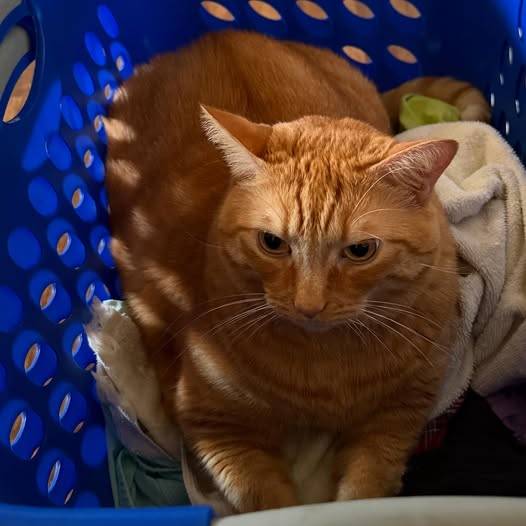
4. This morning as I was about to leave for work I spotted this silly guy in the laundry.
2025 Disneyland Trip #49 (7/9/25)
Jul. 10th, 2025 20:08torachan( Read more... )
New Murderbot Short Story
Jul. 10th, 2025 21:33marthawellsRapport: Friendship, Solidarity, Communion, Empathy
https://reactormag.com/rapport-martha-wells/
Edited by Lee Harris, art by Jaime Jones.
And Murderbot was renewed for a second season!
https://deadline.com/2025/07/murderbot-renewed-season-2-apple-tv-1236453764/
“We’re so grateful for the response that Murderbot has received, and delighted that we’re getting to go back to Martha Wells’ world to work with Alexander, Apple, CBS Studios and the rest of the team,” Chris and Paul Weitz, said in a statement Thursday.
I'm sure
Jul. 10th, 2025 21:21cornerofmadnessI said I was done writing Overlord Husk week stories but walking back to Costco's bathroom Husk proved me wrong.
The
![[community profile]](https://www.dreamwidth.org/img/silk/identity/community.png) sunshine_revival had as part of their questions, communities we're in so I made a list of them, like a 2 page list. I'm going to share them a little at a time with all of you (even though some of you are in that group, not sure anyone else made an obsessive list of them). I didn't copy the all down but I did do some.otherworldly_chemistry This is a community dedicated to rarepairs in the Buffyverse fandom.trope_of_the_month A community for fanworks with a different theme each month.booknook it's about books (I'm a member)everykindofcraft For sharing information, advice and images about all sorts of crafts projects, old or new.
sunshine_revival had as part of their questions, communities we're in so I made a list of them, like a 2 page list. I'm going to share them a little at a time with all of you (even though some of you are in that group, not sure anyone else made an obsessive list of them). I didn't copy the all down but I did do some.otherworldly_chemistry This is a community dedicated to rarepairs in the Buffyverse fandom.trope_of_the_month A community for fanworks with a different theme each month.booknook it's about books (I'm a member)everykindofcraft For sharing information, advice and images about all sorts of crafts projects, old or new.
Fanfiction Masterlist and Portfolio Templates
Jul. 10th, 2025 21:40linky posting in fancodedsmallweb too, but since I know there's a lot of fannish folks here I thought these would be worth sharing here as well!For anyone interested in making a site/section on their site for their fics, here's a really good template for a fanfiction masterlist that just got posted online! Created by
ceu. There's easy to follow documentation on how it works, and links to HTML tutorials if you're not familiar or need a refresher on there as well.As said on the page showcasing the template too, it was inspired by this portfolio template by Kaylee Rowena. Which would be great for anyone who makes fanart! I might end up using this template myself whenever I get to revamping my art galleries on my own site.


Book review: "The Tyrant Baru Cormorant"
Jul. 10th, 2025 17:47rocky41_7 posting in booknookAuthor: Seth Dickinson
Genre: Fantasy
! Spoilers for books 1 & 2 below ! (Book 1 review) (Book 2 review)
‘Biblical grounds’ for white Texan divorce
Jul. 10th, 2025 22:15![[syndicated profile]](https://www.dreamwidth.org/img/silk/identity/feed.png) slacktivist_feed
slacktivist_feedDaily check-in
Jul. 10th, 2025 19:48mecurtin posting in fandom_checkinHow are you doing?
I am OK
13 (68.4%)
I am not OK, but don't need help right now
6 (31.6%)
I could use some help
0 (0.0%)
How many other humans live with you?
I am living single
7 (36.8%)
One other person
8 (42.1%)
More than one other person
4 (21.1%)
Please, talk about how things are going for you in the comments, ask for advice or help if you need it, or just discuss whatever you feel like.
Admin: Poll: Challenge tags
Jul. 10th, 2025 16:33teaotter posting in fan_flashworksfan_flashworks is constantly bumping up against it. So we have an ongoing tag management project to try to gain ourselves some elbow room. You might have seen our periodic posts about merging old single-use fandom tags. Unfortunately, we are coming to the end of the easily-merged fandom tags, and so need to find another way to reduce our tag use.Today's topic: We mods have been talking about the challenge tags (c: amnesty, c: science, etc.) These tags label an entry as responding to a particular prompt (or being part of an amnesty round).
We're not sure if anyone's actually using these! So we wanted to check in with you all before deciding between A) removing them entirely, or B) leaving only the ones from the last 12 months (and only tagging amnesty posts with the amnesty tag). Option A) would make our mod lives easier, but if they are serving a purpose for some of you, we definitely want to take that into account when making our decision. :-)
If we remove the challenge tags, we will change the standard subject-line format for all rounds to "[challenge]: [fandom]: [medium]: [title]", ie, the same as the current format for amnesty rounds. Community members are welcome to go back and add the challenge to the subject lines of previous entries, too (though we know that for some of you, that would be a Herculean task!).
Please take a moment to vote in this poll.
How do you use the challenge tags here?
I don't use them.
11 (61.1%)
I use them to find new-to-me fanworks for a specific prompt.
2 (11.1%)
I use them to filter out fanworks that don’t interest me.
0 (0.0%)
I use them to find specific fanworks on the community that are already familiar to me.
1 (5.6%)
I use them (in addition to my maker tag) to find my own fanworks.
4 (22.2%)
I use them some other way. (Please elaborate in the comments.)
3 (16.7%)
So that's what those tags are! I never knew!
0 (0.0%)
Challenge 485: Face
Jul. 10th, 2025 16:21teaotter posting in fan_flashworksFACE
As always, you can interpret the prompt literally or figuratively, in whatever way works for you.
Each work created for this challenge should be posted as a new entry to the comm. Posting starts now and continues up until the challenge ends at 4pm Pacific Time on Sunday, July 20th. No sign-up required.
Mods will tag your work with fandom and challenge. When you've posted entries to three consecutive challenges, you will earn a name tag, and we'll go back and tag all your previous entries with your name.
All kinds of fanworks in all fandoms are welcome. Please have a look at our guidelines before you play. If you have any questions or concerns, don't hesitate to contact a mod. And if you have any suggestions for future challenges, you can leave them in the comments of this post.
Also, keep an eye out for the next
ffw_social post, which will go up in the next couple of days. If you haven't joined the ffw_social comm, it's never too late to come and check it out. (Posts are locked, which means you have to join to see them.)Admin: Challenge closed
Jul. 10th, 2025 16:20teaotter posting in fan_flashworksStoker: Fanfic: no longer human (the nothing that can’t hurt us), by
bluedreamingTorchwood: Fanfic: Impossible Science, by
badly_knittedSpooks (MI5): Fanfic: Not Quite James Bond, by
smallhobbitKim Possible: Fanfiction: Speaker Phone, by
infinintum_noctemS.W.A.T.: Fan Fiction: Auction Revelation, by
darkjediqueenThe Professionals: Fan Fiction: Torn in Two, by
lucy_romanGundam: Fanfic: Study, by
samuraiterTorchwood: Fanfic: SUV-mersible, by
m_findlowBuffy the Vampire Slayer: Fanfic: Guilt and Pain, by
veronyxk84Guardian: fanfic: Winging It, by
china_shopGreek Myth: Fanfic: In the Family, by
drabblewriterIron Man - Marvel 616 : icons : Do ALL the Science!, by
highlander_iiOriginal Fiction: The Science Behind Shame, by
analogbasiliskScience: City of Streamers: fanfic: by the fancy tie round your wicked throat, by
teaotterCongratulations to
lucy_roman, who earned a name tag!\o/ \o/ \o/
Thank you to everyone who participated! You're now free to post your entries to your journal or wherever else you'd like. If you're archiving on AO3, you can add your work to our fan_flashworks collection there.
New challenge coming right up!
[ SECRET POST #6761 ]
Jul. 10th, 2025 18:12case posting in fandomsecrets⌈ Secret Post #6761 ⌋
Warning: Some secrets are NOT worksafe and may contain SPOILERS.
01.

( More! )
Notes:
Secrets Left to Post: 01 pages, 06 secrets from Secret Submission Post #965.
Secrets Not Posted: [ 0 - broken links ], [ 0 - not!secrets ], [ 0 - not!fandom ], [ 0 - too big ], [ 0 - repeat ].
Current Secret Submissions Post: here.
Suggestions, comments, and concerns should go here.
farmers market
Jul. 10th, 2025 16:57redbirdOne small box of raspberries, because we've had bad luck this summer with over-buying berries, and not eating all of them before them spoiled. I also bought two small cucumbers, and a baguette, even though it's not good baguette weather, because we like Clear Flour bakery's "ancienne" baguettes.
I stopped at Burdick's and got a cup of dark hot chocolate to take out, because it's unseasonably cool and felt like good weather for sitting outside with a hot drink. I didn't buy anything else there, because the chocolate-covered citrus has suffered from shrinkflation: Burdicks is charging almost twice as much as they did a few years ago, for about half as much candy.
The Dean Road station on green line C station isn't far, but it's enough of a hill to be good exercise: I walk quickly on my way to the T unless I make an effort not to, and then the walk back is uphill all the way.
I realized, after posting this but before dinner, that I overdid things and was out of executive function.
Long day but good day
Jul. 10th, 2025 21:57cosmolinguistExeter was great. I saw an old friend C who I'd forgotten had moved there years ago! Lovely to see his new life: his partner and how cozily entangled their lives are, carving out queer space in a city that otherwise doesn't have much; his drag queen persona (I love trans men as drag queens so much); his new and very different career.
The meeting this morning that I was actually in Exeter for seemed to go as well as it could have.
I made good friends with my Guide Dogs counterpart for the day. He covers the southwest and we don't currently have a person to cover the southwest which is why I was there. But he lives so far from Exeter he had also traveled up last night -- we got Told that our meeting was at 10am, even that clearly wasn't ideal for either of us! -- staying in the same Premier Inn as me (it's perfect, you come out of the train station and it's right there ahead of you with a giant sign, most accessible hotel ever). We ran in to each other waiting to board the same bus to the Bad Bus Stops we were here to look at: him with his guide dog and me with my cane, both wondering if the other one was who we thought it was.
We made a good double act, backing each other up on our less well-received points. I'm sad he's so far away! But he's in the part of the southwest I'm more often visiting and I'm super tempted to invite him for a drink if I get the chance!
I had a long journey back, not as crowded or overheated as yesterday's until Birmingham, but with delays it was still two hours after that before I got home.
I stumbled in, drank a lot of ice water, had a shower, ate some dinner (lovely angelofthenorth had made mushroom risotto!), drank some more water, and now I'm lying in front of a fan.
I'm glad to be back home, where there are fans and ice. I bought an iced coffee this morning and there was no ice in it. It wasn't even cold! It was, like, I forgot about this cup of coffee cold, not iced-coffee cold. Ugh. I drank it anyway, but I pined for ice all day. It was 84°F in Exeter, and the first half of our meeting did involve walking up and down a road to look at its terrible bus stops (they really were terrible too -- really did have to be seen to be believed).
I've agreed to go camping this weekend, so I'm enjoying the ice and fans while I can!
At least for camping I won't have to wear my work clothes! I wore a proper shirt for the meeting this morning but immediately afterward took it off of course. I considered jettisoning the binder as well, but the t-shirt I had grabbed to change in to is a tank top and I didn't like that. The binder, my new white one, was extremely visible under the black tank top as it has a higher neckline and wider straps, but I decided that I did not care at all. It was much more comfy and it just looked like I'd layered two different tank tops. The train staff who provided my assistance and checked my tickets didn't misgender me or act weird about it or anything.